





Claire Cirocco received a 2026 Ronald Raven Annual Award, a scholarship providing a tuition stipend, and a 135-hour internship in the Wayne State University Archives. At the end of her internship, Claire wrote this summary of her experience.
Raven Award Intern Blog Post
Beginning my journey in the Master of Library and Information Science program in the fall of 2024, I was determined to pursue a career in archives and initially set my sights on specializing in maintaining audiovisual collections. I have since been granted several amazing opportunities to gain hands-on experience processing both manuscript and audiovisual collections and have expanded my knowledge of the workflows and procedures necessary for long-term preservation of these types of materials. As the most recent recipient of the Ronald Raven Award, I am extremely grateful to have been able to spend more time at the Reuther Library getting my hands, my desk, and the area around my desk dirty as I processed, arranged, and described collections for the university archives.
Over the course of the 135-hour internship I was able to process and create finding aids for four collections totaling a little over 15 linear feet, as well as write a finding aid for a 10 linear foot collection that had been processed a decade prior but was missing the vital contextual and biographical information that finding aids provide. The final manuscript collection I completed before the end of my internship, the H. Warren Dunham Papers, was, to me, the most memorable. Apart from being the largest collection I had processed until that point at 12 linear feet, it was the most engaging in terms of the subjects it addressed.
Henry Warren Dunham was a faculty member of the Department of Sociology and Anthropology from 1940 until his retirement in 1976, as well as a prolific research sociologist. He authored and co-authored numerous books and papers and conducted a plethora of studies regarding mental health and the epidemiology of mental disorders, making significant contributions to the fields of sociology and psychiatry. One of his many accomplishments was the publication of his book "The Culture of the State Mental Hospital," by Wayne State University Press in 1960, a study that was executed by Dunham and Dr. Samuel Kirson Weinberg and brought attention to the ill-treatment of psychiatric patients in state hospitals. If I had more time I would have liked to do a deeper dive into his research. However, an unspoken rule (at least in my mind) in processing archival collections is that deep dives should be kept to a minimum! It is all too easy to fall down the rabbit hole of research, especially if you are a history nerd like me. Processing these manuscript collections provided new meaning and importance to the archival work I was completing, and opening these records to the public will hopefully increase their visibility and overall usage.
In addition to working with manuscript collections, I was also able to process a small film collection, in turn gaining experience working with moving image media, with which I had no prior experience. Under the guidance of Molly Banes, I was able to complete an inventory of the Wayne State University Film Collection which is comprised of over one hundred 16mm promotional and educational films created between the 1930s and the 1990s.
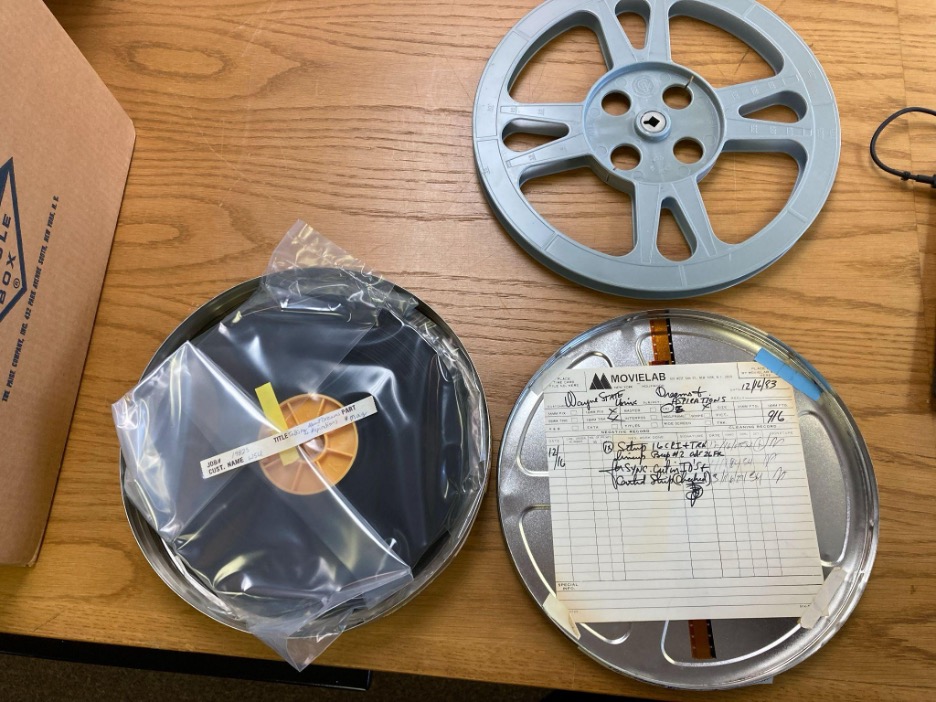
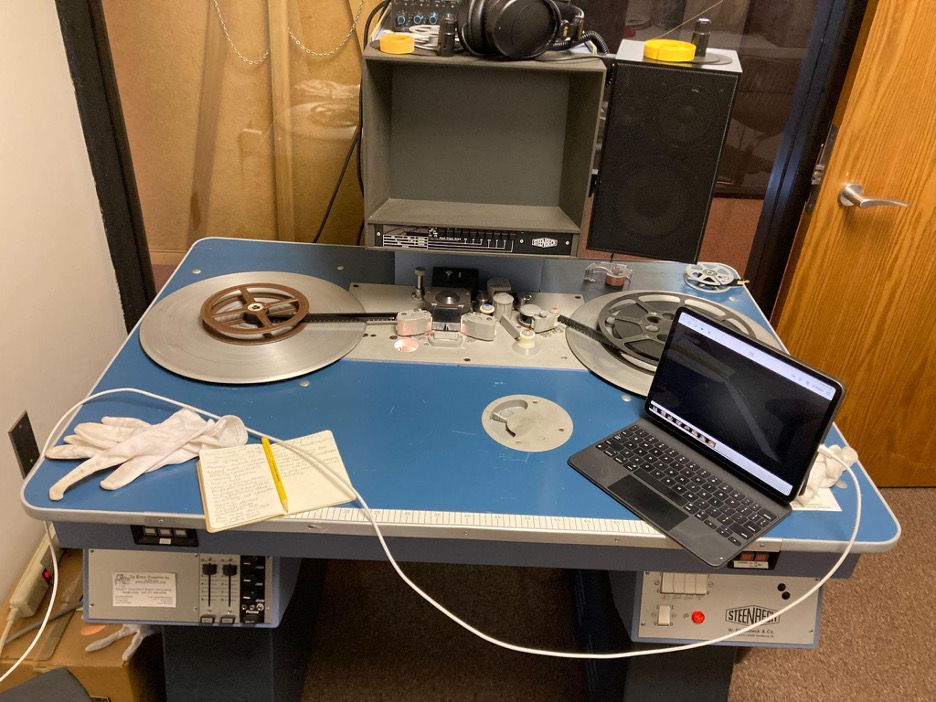
This particular project took place over the course of three days. The first two days were spent populating the University Films Inventory spreadsheet, as I attempted to include as much detail as possible from notes left inside canisters or labels on the film reels’ leader tape. After completing the inventory, Molly and I spent the third day creating screeners for two films using the Steenbeck. The first film, titled “Highlights of 1940 at Wayne,” spanned two silent black and white 16mm reels at around seven minutes each and seemed to be a compilation of a variety of activities and events occurring at the university in 1940, including football and basketball games, theatre productions, homecoming dances, and production of a student radio program. With these two film reels we encountered some issues, mainly in their incorrect orientation on the monitor having been previously wound incorrectly on the reels. When first viewing the image on the monitor in both instances, the picture was both upside down and backwards, and this in turn required a lot of winding and unwinding onto separate reels in order to get the picture aligned correctly. At one point the constant rewinding split one of the film strips and Molly showed me how to properly use a splicer to piece the frames back together. Luckily, this was the only instance in which a film was split, but it was an important lesson in demonstrating the damage that can be caused by constant use of film through projection.
The second film, titled “Detroit Today and Tomorrow” from 1957, appeared to be a promotional film with overdubbed narration in technicolor and optical sound, highlighting different departments of the university and showing students and professors engaging in classroom activities at the medical school, an engineering lab, the law library, and various other locations around campus. It was incredibly interesting seeing both films depicting campus life and activities decades apart and the manner in which the university and the city surrounding it evolved over time, transforming from black and white into technicolor.
Overall, this experience provided further insight into the daily tasks and workflows required of an audiovisual archivist as well as the myriad of potential problems that can arise when handling and projecting film. In completing this project, I not only gained hands-on experience handling film reels, but I learned to assess differences in magnetic and optical sound, black and white and technicolor film, and acquired a basic knowledge of the operation and function of a Steenbeck machine, including how to manually thread film, wind and unwind reels, as well as splice together film that had split due to overuse and degradation.
These two distinctly different methods of processing exposed me to some of the work necessary in maintaining both audiovisual and manuscript collections and were crucial in demonstrating the importance of continued preservation of records and documents charting local history. Archives play a large part in the safeguarding of our cultural heritage, and I am thankful to have been able to participate in this process and to have been able to work so closely with Sarah and Molly, whose patience and assistance throughout the completion of these projects I truly appreciate!
 Reddit
 Facebook
 LinkedIn